Emergency Exit Seats Could Get Less Legroom With This Airbus Concept
Airbus is hoping to make emergency exit seats the same as the rest, with one small tweak.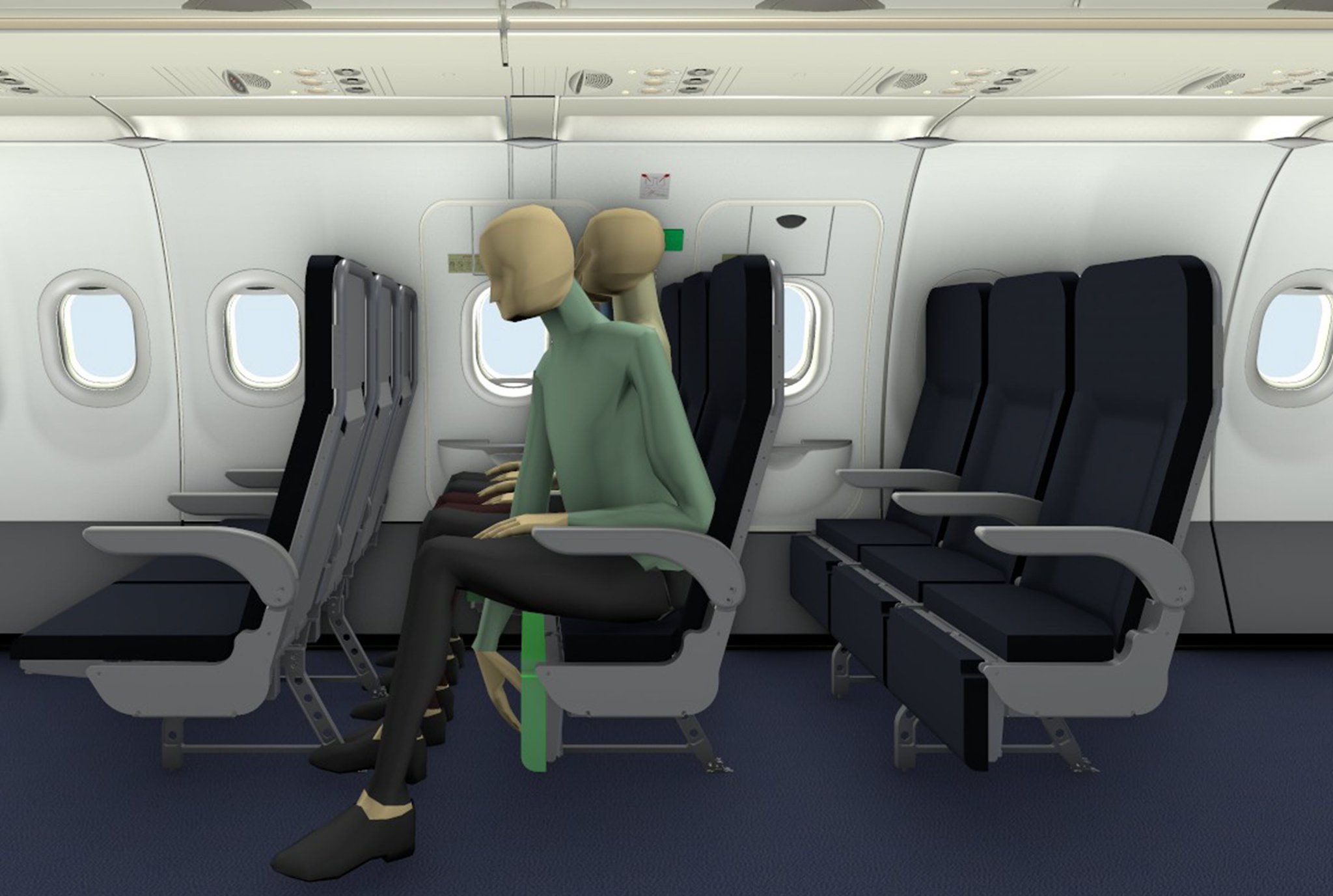
Photo: Airbus
While there are some drawbacks to sitting in the exit row, for most fliers, it’s a price worth paying for all the extra legroom you get. But an Airbus concept suggests that there’s a way for airlines to steal all this lovely legroom, replacing it instead with a folding seat cushion.
Read more: Rolls-Royce Starts Hydrogen Tests On Turbine Engine
For many fliers, snagging an exit row seat is the holy grail of economy class travel. While most airlines charge more for these seats, on some, it’s just the luck of the draw and means a bunch more legroom for your journey.
On aircraft with over-wing exits, the exit row tends to have a seat pitch of around 36 inches (91cm), which is far more generous than the 31 or 30 inches in the rest of the economy cabin. This is done to ensure that passengers can rapidly access the emergency exits in case the situation ever arises. However, on almost all flights, the extra legroom is just a perk for a lucky few passengers.
The downside is that exit row seats have restrictions on who may sit there. Seats can only be occupied by those over 15 years old, those sitting there must be physically capable to operate the exit door, and must not be traveling with pet.
The reason for all these rules is simple – in an emergency, you’re the first to take action. Those in the exit row may be asked to operate the door in an emergency, and will be briefed by the cabin crew on this before takeoff. They need to be able to move quickly, to clear the row and give passage to others who need to leave the plane.
But Airbus has come up with a plan to get rid of that benefit and give all seats equal parity.
The X-tend seatAt 2019’s Crystal Cabin Awards, often referred to as the ‘Oscars’ of aircraft cabin design, Airbus presented a concept it calls the X-tend Seat. This seat is a unique exit row concept, with an automatic stowing mechanism that folds down when the seat is unoccupied. It was designed largely for narrowbody aircraft with overwing exits, but could be used elsewhere too.
The principle of this concept is that, rather than giving all that lovely legroom to the passengers in the exit rows, airlines could give them a normal seat pitch and still have space for an emergency evacuation. Airbus says this will claw back some 10” of space on a narrowbody, which can then be distributed to other seats in the cabin.
In case you were wondering, no, there would not be a lifejacket under your seat. Instead, the life jacket would be stowed under the seat in front. Other downsides of sitting in the exit row persist, such as the age and ability limitations, lack of recline (in some seats), and the ban on keeping your bag on the floor.
On a typical A320neo in an all-economy configuration, there will be 30 rows of seats with 30 to 31 inches of pitch. The extra 10 inches isn’t enough to squeeze in another row of seats, so distributing this spare 10 inches around the cabin will either give 10 rows an extra one inch, or all rows an extra 0.33 inches.
The only realistic benefit of this exit row legroom steal, as far as we can see, would be to give two rows another five inches of pitch each – creating a ‘premium economy’ mini-cabin, or perhaps a short-haul business class product. Considering the work that would need to be done to install this seat and reconfigure the rest of the cabin, we can’t see it being a concept that will be taken much further than this, at least not for the retrofit market.
Opportunity for budget carriers?While a retrofit to add such little legroom across the cabin might not be economically viable, some ultra-low-cost carriers might make the most of the 10" extra available in the cabin.
Reducing the seat pitch across the cabin from 30" to 28" opens the door for two more rows to be added, a huge revenue-generator for airlines. In one move, Airbus will have managed to remove the coveted exit row seats and reduce legroom for everyone else. Certainly not great for passengers though.
However, in reality, the X-tend seat is unlikely to reach aircraft soon. Airlines make millions in ancilliary revenue selling emergency exit seats and the cost of a new cabin configuration will likely outweigh any major benefits. But never say never, lest another ultra-low-cost-carrier (ULCC) springs up and looks to cramp as many seats in as possible.
Джерело інформації: Simple Flying