How Pilot Error Downed SAS Flight 933 On This Day In 1969
The McDonnell Douglas DC-8-62 came down in the sea just off the coast of Los Angeles. What causal factors contributed to the accident?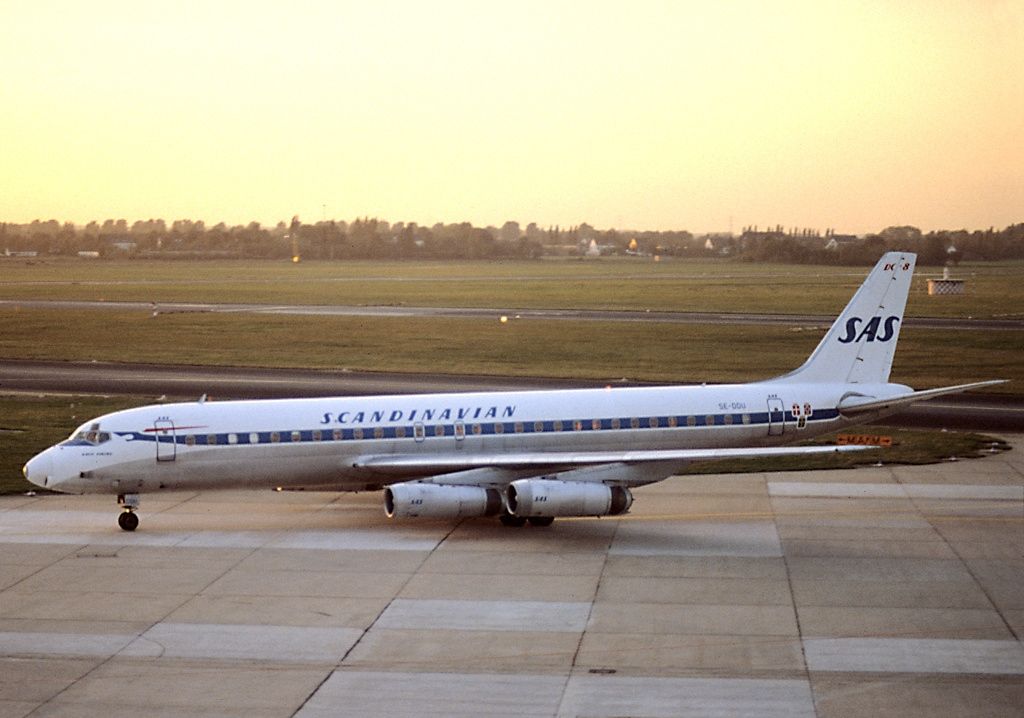
Photo: Feliz Goetting | Wikimedia Commons
54 years ago today, Scandinavian Airlines (SAS) flight SK933 crashed into the sea while on approach to Los Angeles International Airport (LAX). Of the nine crew members and 36 passengers onboard, 15 perished in the accident. The subsequent investigation concluded that the crash was caused by pilot error.
A detailed look at the accidentThe flight departed Copenhagen Airport (CPH) earlier that day, bound for Los Angeles, operated by one of the airline’s long-range narrowbody aircraft, the McDonnell Douglas DC-8-62. The aircraft in question, named Sverre Viking, was delivered new to the airline in June 1967.
Flight SK933 made a scheduled stop at Seattle-Tacoma International Airport (SEA) en route to California, where there was a change of crew.
The first officer was flying the Seattle to Los Angeles leg of the journey, and the captain was pilot monitoring. Both pilots had a substantial amount of experience on the aircraft, having each flown over 900 hours on the DC-8-62. After holding for 90 minutes, flight SK933 was then cleared to descend, in preparation for a back course ILS approach over the sea onto runway 07R.
However, SAS pilots were not authorized to carry out back course ILS approaches at Los Angeles, and so the crew decided to conduct a VOR approach instead. A VOR approach provides no vertical guidance, and at the time of the accident (19:21 PST), the sky was dark, and the pilots lacked any visual ground references.
To complicate matters further, when it came to releasing the aircraft’s landing gears, the light to confirm that the front landing gear had been correctly deployed did not illuminate. This led to a discussion with the flight engineer, and the captain considered a diversion if the issue could not be resolved and informed ATC of the situation. This was the last recorded contact with the aircraft.
In the one minute and 16 seconds that followed, the aircraft descended to near sea level. As part of the investigation, the first officer recalled seeing the altimeter approaching zero. He attempted to pull back up, but by this time, it was too late, and the aircraft hit the water tail first, causing the fuselage to break into three pieces.
After impact, the surviving passengers, who were distributed fairly evenly throughout the aircraft, were evacuated by the crew onto the wings and into the life rafts. The forward section of the fuselage remained afloat for around 24 hours after the accident and was later towed to shore for investigation purposes. The rest of the aircraft, as well as the remains of 11 those onboard, were never recovered.
The investigation and aftermathThe crash happened in international waters, so the investigation was conducted in line with the Convention on International Civil Aviation. The investigation revealed a series of smaller events that, when combined, led to a breakdown of crew resource management.
- The first officer had incorrectly set his altimeter at the start of the descent, which was never noticed.
- Both pilots were more accustomed to landing on LAX’s runway 25 – neither had carried out a back course ILS approach and landing on runway 07R before.
- During landing, a critical phase of flight, the first officer was distracted from flying the aircraft by the confusion surrounding the deployment of the landing gear, and had not realized the aircraft had descended so low.
- The flight was running around three hours behind schedule due to earlier delays picked up in its journey, and the resultant time pressure felt by the crew is believed to have also been another contributory factor.
The investigation commission reached the following conclusion:
“The accident was the result of a series of events that in and of themselves would not have caused the accident, but in combination caused a breakdown in the cross-checks and cockpit discipline required for a safe air carrier operation.”
Джерело інформації: Simple Flying