What is Landing Distance & How Is It Calculated?
One of the most critical phases of flight.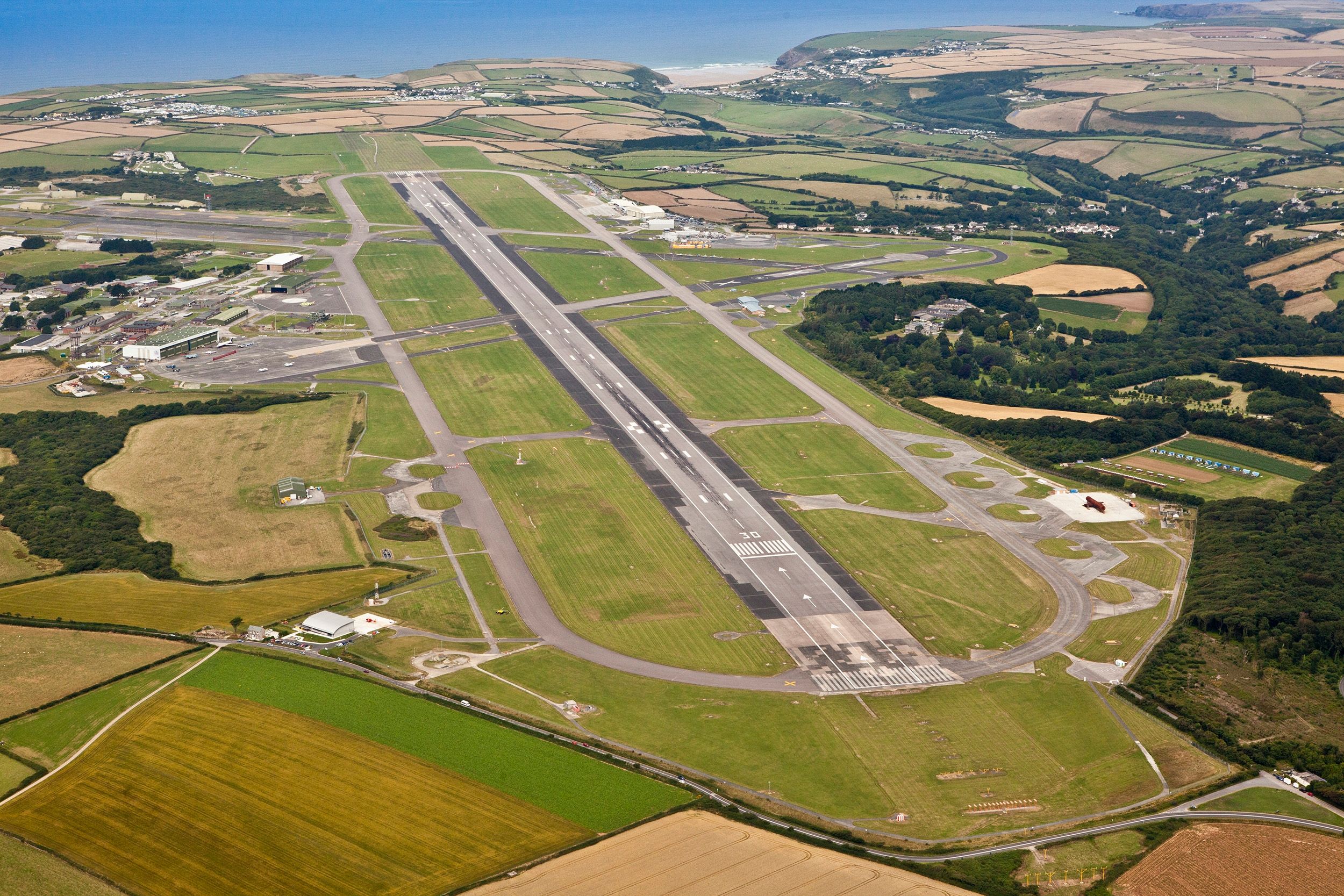
Photo: Cornwall Airport Newquay
The landing phase is one of the most critical phases of flight; most accidents and incidents occur during this phase. Among many other things, the landing distance calculation is one of the most essential calculations that must be performed to ensure a safe landing. Many regulations concern the landing distance of an aircraft.
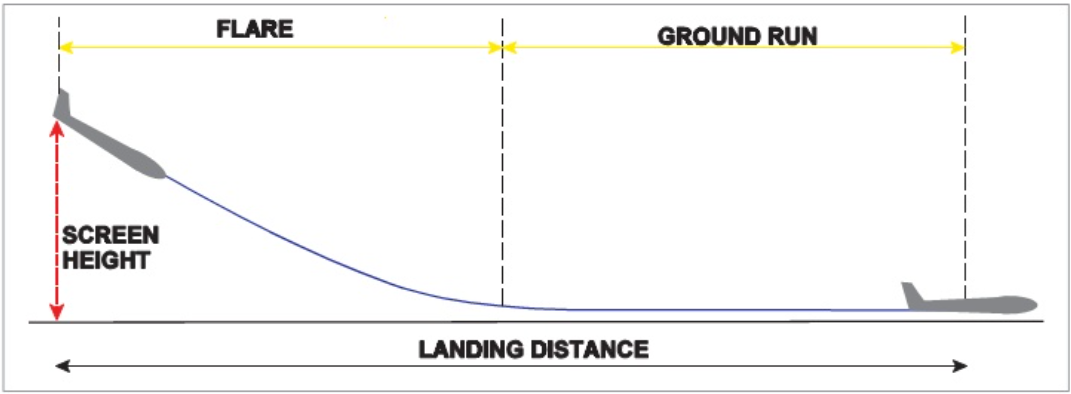
What is the landing distance required?For a transport category aircraft certified as a large aeroplane (EASA CS-25), the landing distance commences from 50 ft above the runway threshold and ends when the aircraft comes to a complete stop. This 50-foot distance is called the screen height and is a fixed value for all aircraft certified under CS-25.
The landing distance can be divided into two parts: an airborne section and a ground run. The airborne portion of the landing starts at 50 ft, where the aircraft is at the correct approach and landing speed, known as Vref (landing reference speed), over the runway threshold. It ends when the main wheels of the aircraft touch the ground. This marks the beginning of the ground roll, which ends when the aircraft comes to a stop.
The total of the above is considered an aircraft's required landing distance, also known as Actual Landing Distance (ALD). ALDs are tested by the manufacturer during the aircraft certification process and are mentioned in the flight manual.
What is the landing distance available?
The Landing Distance Available (LDA) concerns a given aerodrome runway. It represents the distance from the point on the runway at which an aircraft can commence its landing to the point where the surface can no longer bear an aircraft's weight. At almost all airports, the landing distance is from one runway threshold to the other. A runway with a displaced threshold cannot be utilized for landing distance calculation.
What is the landing distance required?When it comes to landing distance requirements, there are two conditions to consider. One is the calculation of landing distance when the aircraft is dispatched, and the second is done inflight right before the landing.
Landing distance assessment at the time of dispatchAccording to regulations, when an aircraft is dispatched to an airport, it must be able to land within a certain percentage of the landing distance available at the field.
For a turbojet aircraft, it must be possible to make the landing within 60% of the Landing Distance Available (LDA). And for a turboprop, it must be able to make the landing within 70% of the LDA. However, for turbojet aircraft, an extra 67% of its Actual Landing Distance (ALD) must be added to the final landing distance calculation, and 70% for turboprop aircraft. This multiplied aircraft ALD is known as the Required Landing Distance (RLD).
For example:
An Airbus A320 is to be dispatched to an aerodrome with a runway length of 8000 m. According to the aircraft performance, for a dry runway, it has an ALD of 1100 m. Can it be dispatched?
- 60% of 8000 m (LDA) = 4800 m
- 67% of 1100 m (ALD) = 737 m
So RLD = 1100 + 737 = 1837 m, and 1837 m is less than 4800 m.
Our calculations show that the aircraft has an RLD of 1837 m, less than 4800 m. In this case, the aircraft can safely be dispatched to the airport without issues. For a turboprop, the calculations are similar, but the numbers are different as it must be able to land within 70% of an airfield's LDA, and the turboprop's RLD is also its original ALD plus 70%.
For wet runways, 15% of RLD must be added. If we take the example above, the initial RLD is 1837 m. So, when we add 15% of 1837 m to 1837 m, the wet RLD equals 2113 m.
For contaminated runways, if the flight manual has specific data for landing distance with different contaminants, those values must be used. When the manufacturer provides contaminated ALD, this must be converted to an RLD (67% of the contaminated ALD), and then 15% of that contaminated RLD must be added to get the final measurement. If contaminated data is not available wet runway performance must be used.
Landing distance at the time of arrivalThe Landing Distance at the Time of Arrival (LDTA) is a more recent addition to regulations. The purpose of LDTA is to give pilots a more realistic landing distance.
Traditionally, the Actual Landing Distance (ALD) given by the manufacturer in the flight manual is considered the base performance of the aircraft. But the ALD is not realistic for the following reasons:
- It is calculated only on a dry runway.
- It assumes a touch-down rate of 480 ft/min.
- It assumes full manual braking after landing.
- Speed is considered under standard conditions.
- It does not usually consider the effect of runway slope.
- It is performed by a test pilot whose primary aim is to reduce the landing distance as much as possible so that the aircraft can be marketed well.
Test flight performance data cannot be achieved in a routine flight because:
- Runway conditions change.
- The touch-down rate is lower than 480 ft/min; a typical landing descent rate rarely even reaches 300 ft/min.
- Full manual braking is not used to reduce brake wear, and most large aircraft use auto brakes.
- Standard atmospheric conditions do not exist in real life, so speed variations can occur.
- Changes in the wind can cause adjustments in landing technique and distance.
- The runway slope is a factor.
- Airline pilots perform landings with varying skills, and the idea behind a safe landing is not to reduce the distance as much as possible.
An LDTA, thus, helps pilots to calculate their landing distance much more correctly. These days, the ATC can give the pilot accurate information on the runway condition based on a Runway Condition Assessment Matrix (RCAM). Using the RCAM, the pilots are provided Runway Condition Codes (RWYCC), calculated every 1/3 of the runway. The RWYCC codes are numbered from 1-6. These numbers account for how good the braking performance is. For instance, 5 is considered good, 3 is considered medium, and 1 is considered poor.
ATC or the airport authorities issues the code as #/#/#, for example, 6/5/4, where each number accounts for a different part of the runway. In this case, the first section has a braking action of 6, the second has 5, and the third has 4. Pilots can choose to use the lowest number as the braking action or the mid-number when a code is given. The mid-number is applicable because most of the braking during a normal landing occurs in the middle area of the runway. If it is a heavy aircraft, then the last part of the runway may also be applicable. Ultimately, this will be decided by the commander of the aircraft.
Джерело інформації: Simple Flying