ESA Forest Science Mission To Harness P-Band Radar Technology
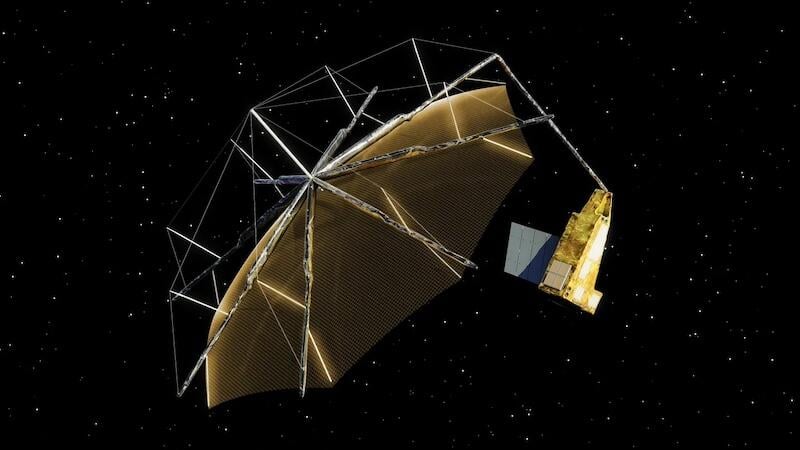
A rendering of the Biomass satellite which will be orbited in April.Credit: Airbus
TOULOUSE—Scheduled for launch in April, the European Space Agency's (ESA) Biomass mission will help scientists better understand how forests act as carbon sinks, experts said Feb. 11 as the satellite was in the final stages of preparation.
The project aims to take stock of the biomass in the world's forests and monitor its evolution.
The novel use of a 100-watt, P-band synthetic aperture radar will enable wood quantity measurement below the foliage. “We will see the structure of forests in a new way,” said Chris Lloyd, Biomass project manager at Airbus. Biomass is the first satellite to carry a P-band radar, the main feature of which is a piercing 70-cm (28-in.) wavelength.
The resulting images will represent 200x200-m (656x656-ft.) squares. For deforestation, resolution will be better, as Biomass will detect 50-m-wide changes. The radar's spot beam has a width of 60 km (37 mi.).
Simultaneously using interferometry, scientists will obtain the equivalent of X-ray photographs and CT scans, thus mapping the forest in three dimensions. In addition, they will get masses of wood per unit of surface area.
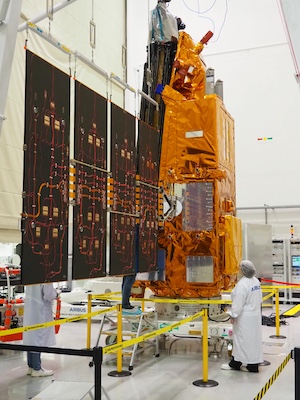 Credit: Airbus
With a margin of error of 20%, accuracy will be similar to what forestry workers achieve on the ground. The difference is Biomass will make those measurements on a global scale. The difficulty lies in the complex structure of trees, the presence of water inside and the indirect evaluation of mass.
“We will measure density and see whether an area is dry, or degraded compared to neighboring areas,” Cheli said. “We have little information on where most carbon is stored and where most change happens: the tropics,” Bjorn Rommen, ESA's Biomass mission scientist, emphasized. The satellite will cover the entire planet in nine months and is expected to operate for a minimum five years. Researchers may use data and algorithms on an open basis, Rommen said, hoping for unexpected findings.
“Forests absorb 8 gigatons of CO2 per year, or one third of the CO2 emitted by human activities,” he continued. “Uncertainties remain—dispelling them is part of mission.”
Airbus UK has been the prime contractor, leading a consortium of more than 80 companies. Lifting off from Europe's spaceport in Kourou, French Guiana, a Vega-C launcher will place the 1.25-metric-ton Biomass satellite into a Sun-synchronous orbit at an altitude of 666 km.
While it was devised as a science mission, Biomass also will contribute to the execution of the EU's environmental policy. The collected data can both serve researchers and monitor forest health. It will thus support Europe's continued efforts to address climate change, whereas the new U.S. administration has no interest in the matter.
Forests absorb double the emissions that they emit, said Simonetta Cheli, ESA's director of Earth observation. And the emissions come mostly from deforestation, wildfires and the human use of wood as an energy source.
“We will better understand the canopy, the health of a forest, the height of trees, all that is related to the carbon cycle,” Cheli said. “The quality of a forest is related to the type of leaves, trunks, stems... each of them provides a different contribution to the carbon cycle... Biomass is particularly relevant for the monitoring of carbon fluxes.”
“You see the type of role Europe plays—hopefully, it will play a [more important] role in a geopolitical context where some partners disengage,” she said. ESA has been working more closely with the European Commission on Earth observation, she added. “The Commission uses every set of data to monitor the implementation of a legislation,” Cheli said.
Джерело інформації: Aviation Week