NASA Budget Makes Deep Cuts Across Aeronautics Research Portfolio
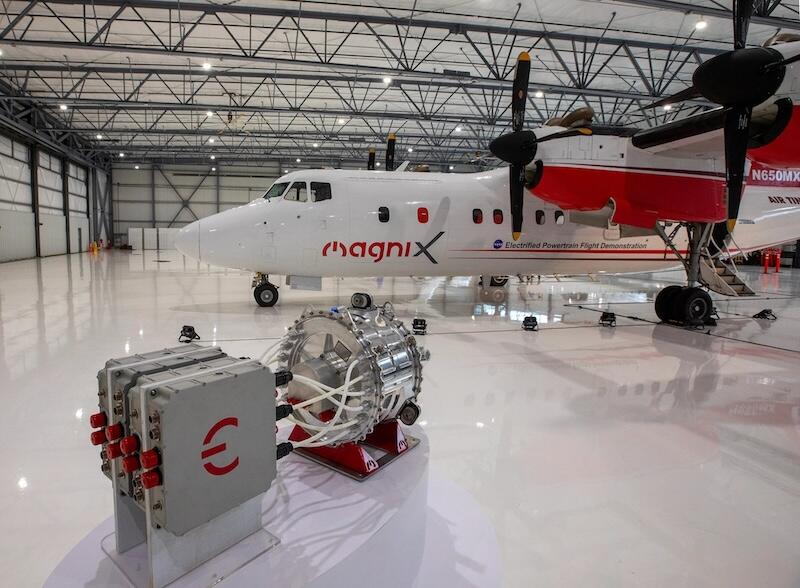
MagniX’s NASA-funded hybrid-electric flight demonstrator is a key part of the startup’s plans to certify its electric propulsion units.Credit: David C. Bowman/NASA
Plans to fly two hybrid-electric propulsion demonstrators are among the victims of the Trump administration’s decision to cut funding for green aircraft technologies from NASA’s aeronautics research budget.
Work on and funding for the Electrified Powertrain Flight Demonstrator (EPFD) projects at GE aerospace and MagniX are to stop at the end of 2025 under NASA’s proposed budget, which cuts spending on aeronautics research to USD 588.7 million in fiscal 2026 from USD 935 million in 2025, a cut of 34%.
The budget calls for NASA in fiscal 2026 to develop a new strategy to maintain U.S. leadership in aviation and focuses aeronautics research in four main areas: rapid, high-fidelity computational design and analysis tools; commercial supersonic and hypersonic flight; automated airspace management; and “revolutionary” propulsion for future airliners.
Gone is the X-66 Sustainable Flight Demonstrator (SFD). Small-core engine research will be delayed by a year and rescoped. The proposed budget eliminates contrails research and reduces work on aircraft emissions and electric propulsion. Research into commercial supersonic landing/takeoff noise and high-altitude cruise emissions will be reduced.
With the cuts expected to reduce their utilization, up to five of NASA’s 12 wind tunnels will be put into “standby mode” and receive minimal maintenance. The Trump administration’s budget proposal says the cuts will “help develop a leaner and more cost-efficient aeronautics research organization.”
The deepest cuts hit NASA’s Advanced Air Vehicles Program (AAVP) and Integrated Aviation Systems Program (IASP), funding for which will be almost halved. AAVP will be reduced to three projects from six, including closeout of the Hybrid Thermally Efficient Core (HyTech) and Revolutionary Vertical Lift projects.
Research in support of advanced air mobility will be reduced to developing computational tools, but NASA will continue the High-Rate Composite Manufacturing (HiCAM) project to demonstrate fabrication and assembly technologies to enable production of up to 80 single-aisle aircraft a month.
IASP will continue the X-59 Low Boom Flight Demonstrator project to survey community response to reduced sonic booms, but the X-66 will be replaced by the inaptly named Subsonic Flight Demonstrator (SFD) project to conduct a full-scale ground test of thin-wing technology for future commercial aircraft.
Once the SFD, HyTech and HiCAM projects are completed, NASA will focus on revolutionary propulsion capabilities, according to budget documents.
Contractor delays and technical issues with the X-59 forced a program replan, and the Lockheed Martin-built aircraft is now expected to fly in September, with acoustic validation flight tests to be completed by the third quarter of fiscal 2027. But a schedule for planned community response survey flights was not provided.
The Airspace Operations and Safety Program will focus on developing tools for the FAA to reduce airline delays and operating costs, but fewer technologies will be validated through flight and more through simulation only. The budget eliminates the development of vehicle safety technologies.
The Transformative Aeronautics Concepts Program will “rapidly” phase out research related to emissions and climate issues, eliminate the early-stage Convergent Aeronautics Solutions project and cut back on funding for university research.
Джерело інформації: Aviation Week