Passengers Describe Terrifying Emergency Descent On Spring Airlines Japan Boeing 737
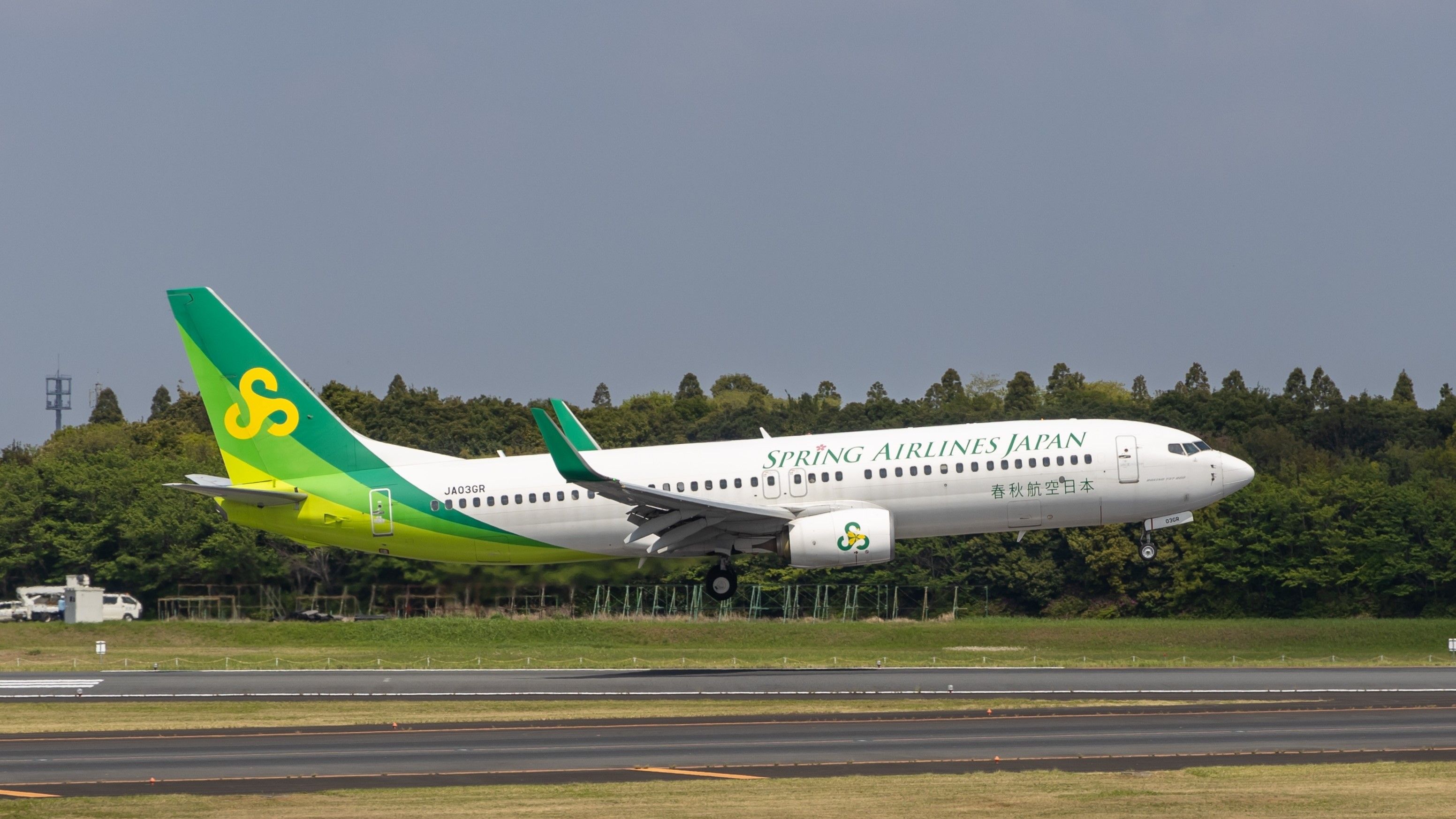
A Spring Japan Boeing 737, operating a flight from Shanghai Pudong International Airport (PVG) to Tokyo Narita Airport (NRT) on June 30, was forced to make an emergency landing at Osaka’s Kansai International Airport (KIX) after the aircraft experienced issues with cabin pressurization.
The crew rapidly descended to bring the aircraft to a safe altitude, with oxygen masks being deployed in the cabin. While the aircraft landed safely, some passengers feared for their lives as the flight rapidly descended from 36,000 ft. The aircraft involved in the incident remains on the ground.
Rapid Descent From Cruising AltitudeAs reported by Kyodo News, the incident occurred on Flight JL8696/IJ004, a code-share flight between Japan Airlines and its low-cost subsidiary Spring Airlines Japan. The Ministry of Land, Infrastructure, Transport, and Tourism confirmed that the aircraft alerted the pilots of an abnormality in the pressurization system, which maintains adequate pressure in the cabin.
Suspecting cabin depressurization, the flight crew immediately contacted air traffic control, declared an emergency, and diverted to Kansai Airport. Passengers reported that the aircraft descended from about 36,000 ft to nearly 10,000 ft within 10 minutes. Some passengers feared the plane would crash as the oxygen masks came out.
One passenger reportedly recalled being on the “verge of tears,” and began writing their will and bank and insurance details. One passenger told AP,
“I heard a muffled boom, and the oxygen mask fell off in a few seconds. The stewardess cried and shouted to put on the oxygen mask, saying the plane had a malfunction.”
Safe Landing Without Further IncidentAccording to Flightradar24, the flight departed Shanghai at 17:48 local time. It typically takes two and a half hours to fly to Tokyo. However, the aircraft flew towards Osaka and landed at 20:48 local time. There were 191 passengers and crew onboard, and there were no injuries reported. The affected passengers were reportedly given 15,000 yen (USD 93) for transportation and were provided with one night's accommodation.
The flight was operated by a Boeing 737-800, registration JA06GR. It was built in June 2017 and delivered that same month. While on lease from BOC, the narrowbody is operated by Spring Japan, a Narita-based low-cost carrier. On June 30, the aircraft operated four flights between Tokyo Narita, Shanghai, and Sapporo. It has not operated any flights since the incident.
Spring Japan currently has nine aircraft in its fleet, including six Boeing 737-800s and three Airbus A321-200 converted freighters. From Tokyo Narita, the airline flies to two domestic destinations and seven destinations in China. Meanwhile, China’s Spring Airlines also flies between Shanghai and Tokyo. While the Chinese LCC holds a 33% stake in Spring Japan, it does not participate in its operations or management. Japan Airlines is the majority shareholder in Spring Japan.
Flights Canceled After The IncidentFlight JL8696/IJ004 from Shanghai to Narita runs daily, seemingly with a different schedule every day. It is one of up to 108 weekly flights scheduled on the route. According to data from Cirium, an aviation analytics company, China Eastern is the top carrier on the route with 34 weekly flights, followed by Air China with 31 weekly flights.
Other carriers operating on the route include Spring Airlines, China Southern, Juneyao Air, All Nippon Airways (ANA), and Jetstar Japan. However, Spring Japan’s service is not listed in Cirium’s database. Following the incident, the Japanese carrier canceled multiple flights on Tuesday and Wednesday due to “ship rotation.”
The airline has canceled flights JL8695 (IJ003) and JL8696 (IJ004) between Tokyo and Shanghai, as well as IJ833 and IJ834 between Tokyo and Sapporo, Japan, on July 3. It also canceled flights IJ621 and IJ622 between Tokyo and Hiroshima, and IJ253 and IJ254 between Tokyo and Tianjin on July 3. Affected passengers can choose to rebook their flights or get a refund, with full refunds available within 30 days after the scheduled flight only. The airline apologized for any inconvenience.
Джерело інформації: Simple Flying